Agentic RoboticsVariational Automation Benchmark (VABAR)
- Industrial
- Built-in Skill Library
- Deformable
- 6 task classes
- Physics Feedback
- Newton
 Code (Nov 9)
 https://arxiv.org/abs/2611.06881
1Siemens2NVIDIA3UC Berkeley*Equal contribution
1What is Variational Automation?
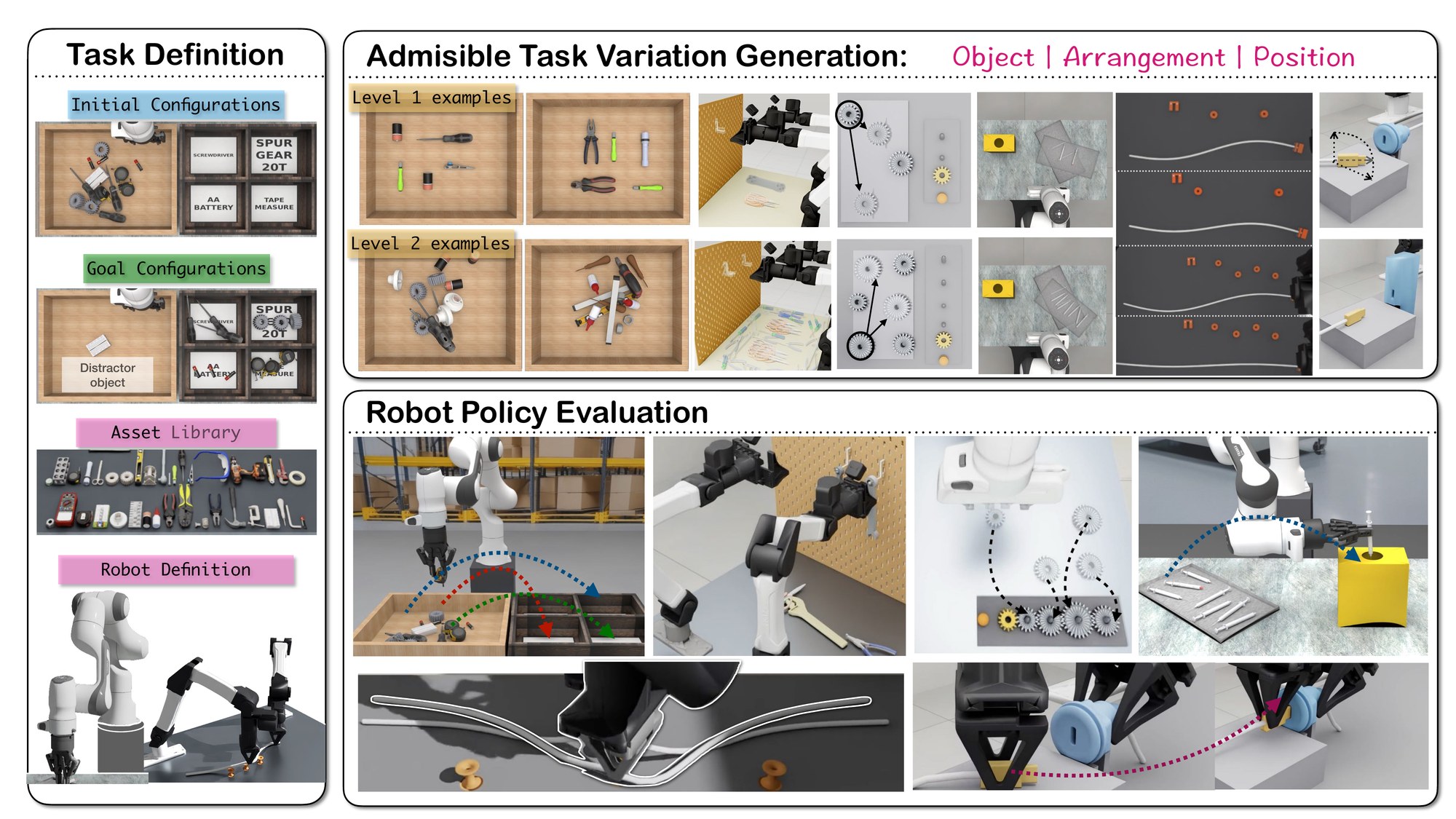
Variational Automation (VA) is a class of tasks where a robot persistently performs varying instances of a specific task, with known variation in object shape and pose: sorting tools into bins, hanging them on a pegboard, routing cables in a data centre. The workcell, robot and sensors are fixed and the range of objects and poses is bounded, so a system can reuse object models, calibrated sensors and modular skills while still adapting to every new instance.
Fixed Automation
A robot repeats identical instances with the same motions, as in spot welding or spray painting. Reliable and fast, but with no adaptivity.
Variational Automation
A robot repeats varying instances: objects vary in geometry and pose within a known, bounded workcell. This is what VABAR evaluates.
Generalist Robotics
A robot performs a broad variety of open-ended tasks, mostly with end-to-end policies. Highly flexible, but not yet at industrial reliability.
2How coding agents do on VABAR
Agentic robotics systems write robot policies as code and improve them from what happens in simulation. We gave eight coding models the same skill library and the same execution feedback on five VABAR tasks. Zero-shot success says little about which agent will improve: models that start within a few points of each other end up 30 points apart after two rounds of feedback.
zero-shot policy (@0)after two rounds of execution feedback (@2), logo = model providerhuman-authored policy
3The skill library
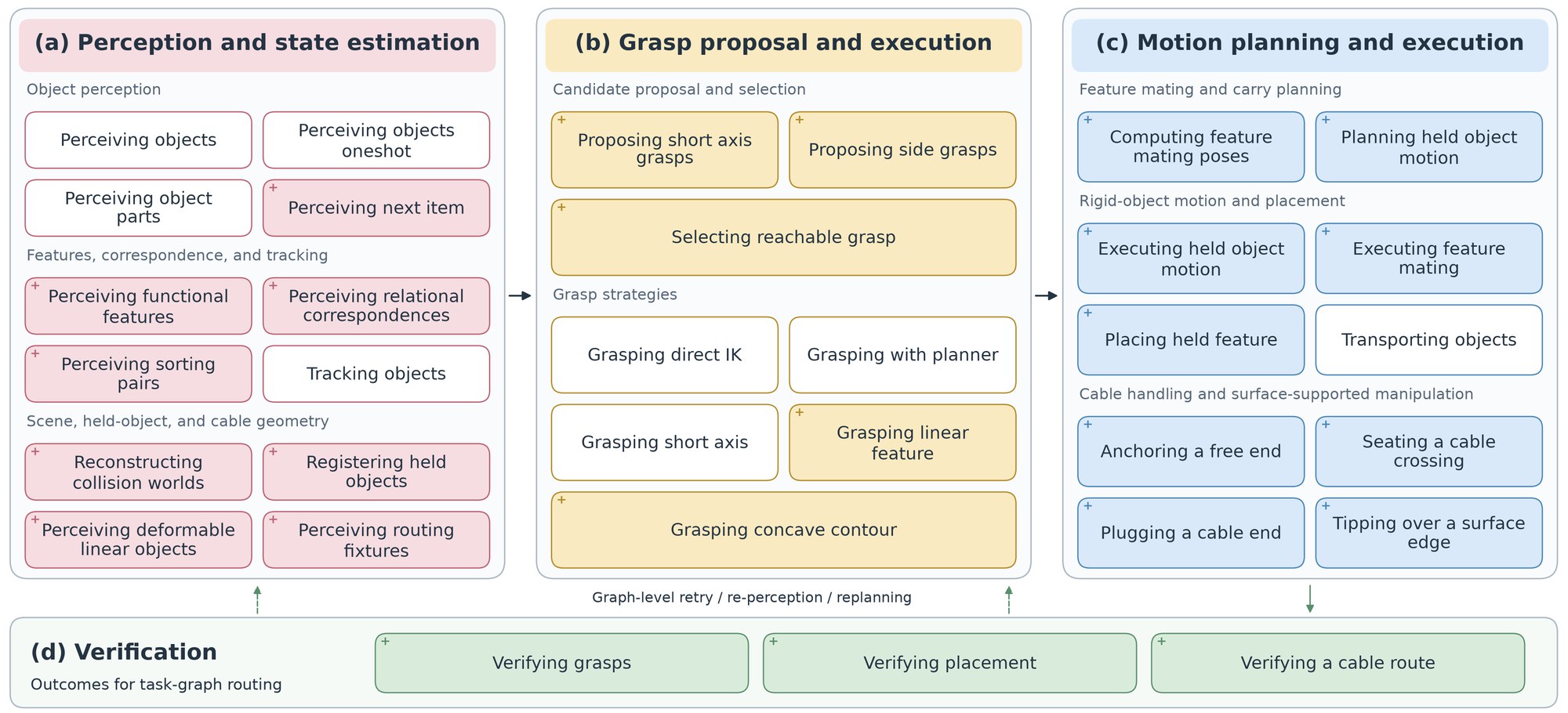
VABAR extends the Modular Open Robot Skill Library with reusable procedures for functional-feature manipulation, constrained placement and deformable cable handling: metric feature localization, source–destination correspondence, in-hand registration and staged feature mating. Cable skills estimate and track ordered 3D centerlines and support anchoring, routing and terminal placement.
4Variation at two levels
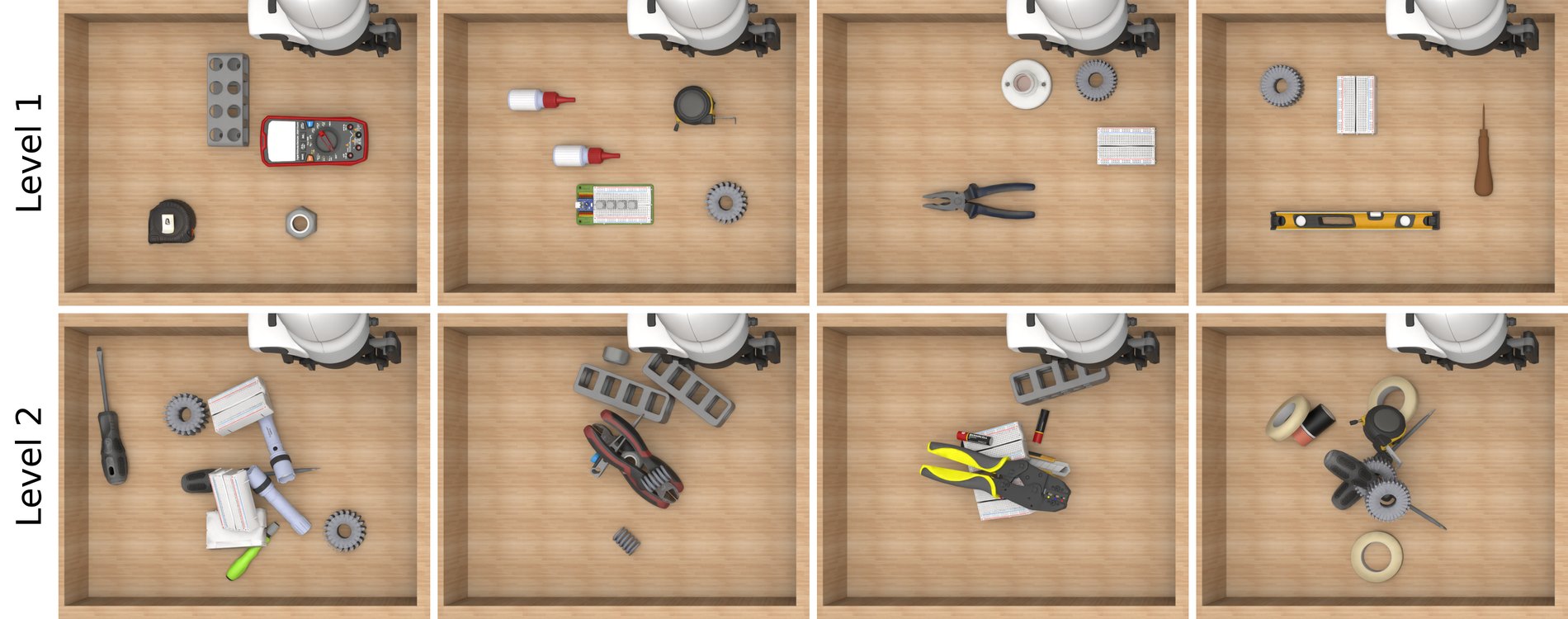
Each clip is a flip-book of initial conditions, not a trajectory: every frame is one independently seeded instance of the same task class, held for half a second. Level 1 and Level 2 run the same sampler under different bounds; what changes is the width of the admissible region, not the objective.
Varies: Tool type · clutter · bin occupancy
Varies: Tool type · fixture type · object and fixture poses
Varies: Gear count · gear size · initial pose
Varies: Syringe type · clutter · disposal geometry
Varies: Connector pose · port pose
Varies: Fixture layout · route · cable type
Figure 5. Seeded initial scenes per task and level. Instances are drawn under a controlled seed, so re-running a task specification reproduces the same scenes.
See task definitions, components and execution records →
Citation
@misc{xie2026vabar,
  title  = {VABAR: A Variational Automation Benchmark for Agentic Robotics},
  author = {Shuangyu Xie, Kaiyuan Chen, Uksang Yoo, Xinyue Zhu, Meadow Shen, Jaimyn Drake,
            Eugen Solowjow, Lionel Gulich, Alexander Millane, Rafael Cathomen, Tuur Stuyck,
            Sangeeta Subramanian, Yichao Pan, Bruce McGowan, Michael Benedict, Linxi Fan,
            Yuke Zhu, Spencer Huang, Ken Goldberg},
  year   = {2026},
  eprint = {2611.06881},
  archivePrefix = {arXiv},
  primaryClass  = {cs.RO},
  url    = {https://arxiv.org/abs/2611.06881}
}