Benchmark details
1The six task classes
Each class fixes an operational objective and an application setting, then names the axes along which instances vary. Tasks 1–4 run on the single-arm Franka; tasks 5 and 6 use the bimanual YAM.
Task 01Tool Sorting
The robot must place industrial tools into corresponding bins. Instance variation is introduced by changing the tools, their poses, and tool density.
- L1
- Singulated tools with no distractors.
- L2
- Cluttered tools that overlap and occlude one another.
Reference graph (Newton): L1 47.1% · 421.6 s; L2 33.7% · 913.8 s. Clip: Level 2 · 9× speed.
Task 02Tool Hanging
The robot must pick up one or more industrial tools (wrenches, screwdrivers, hammers, scissors) and hang or insert them into designated hooks, clips or slots on a pegboard. Variation comes from tool type, the number of tools, initial tool pose and holder pose.
- L1
- One tool; known fixture pose.
- L2
- Multiple tools and fixture types; randomized poses.
Reference graph (Newton): L1 86.7% · 86.1 s; L2 81.7% · 158.4 s. Clip: Side view · 4× speed.
Task 03Gear Meshing
The task input is gears and axles. The robot must pick up multiple gears, assemble them onto axles so that they properly mesh, and press a button to activate the mechanism. Variation covers the number of gears, gear size and initial gear poses. To ensure physically valid instances, scenes can be initialised from a valid assembled configuration before selected gears are removed and repositioned.
- L1
- Assemble two gears.
- L2
- Assemble three gears.
Reference graph (Newton): L1 100.0% · 165.9 s; L2 90.0% · 235.5 s. Clip: Front view · 4× speed.
Task 04Syringe Packing
The robot must place syringes into a disposal container while avoiding distractor objects. Instance variation includes the number of objects and the disposal box type.
- L1
- Singulated targets.
- L2
- Cluttered scenes with diverse syringe types.
Reference graph (Newton): L1 87.0% · 228.8 s; L2 63.0% · 472.3 s. Clip: Agent view · 9× speed.
Task 05Cable Insertion
The robot must pick up a connector, align it with a USB-C port and fully insert it. Instance variation includes the position and orientation of the connector and the port.
- L1
- Fixed, visible port; nearby connector with small misalignment.
- L2
- Randomized port pose; moderate connector misalignment.
Reference graph (Newton): L1 86.7% · 78.8 s; L2 30.0% · 74.2 s. Clip: Wrist + support · 3.5× speed.
Task 06Cable Routing
The robot must route a flexible cable around a specified ordered sequence of cylindrical fixtures mounted on a planar routing board. The task varies the number, position and spacing of pegs; the ordered target sequence; cable length; initial cable configuration; cable slack and curvature; endpoint position; and the 3D pose of the routing board.
- L1
- 2–3 widely spaced pegs; short route; low turning angle.
- L2
- 4–6 moderately spaced pegs; multiple turns; moderate initial cable variation.
Reference graph (Newton): L1 46.7% · 116.0 s; L2 46.7% · 189.8 s. Clip: Corner view · 5× speed.
2What the benchmark ships
| Component | Choice | Purpose |
|---|---|---|
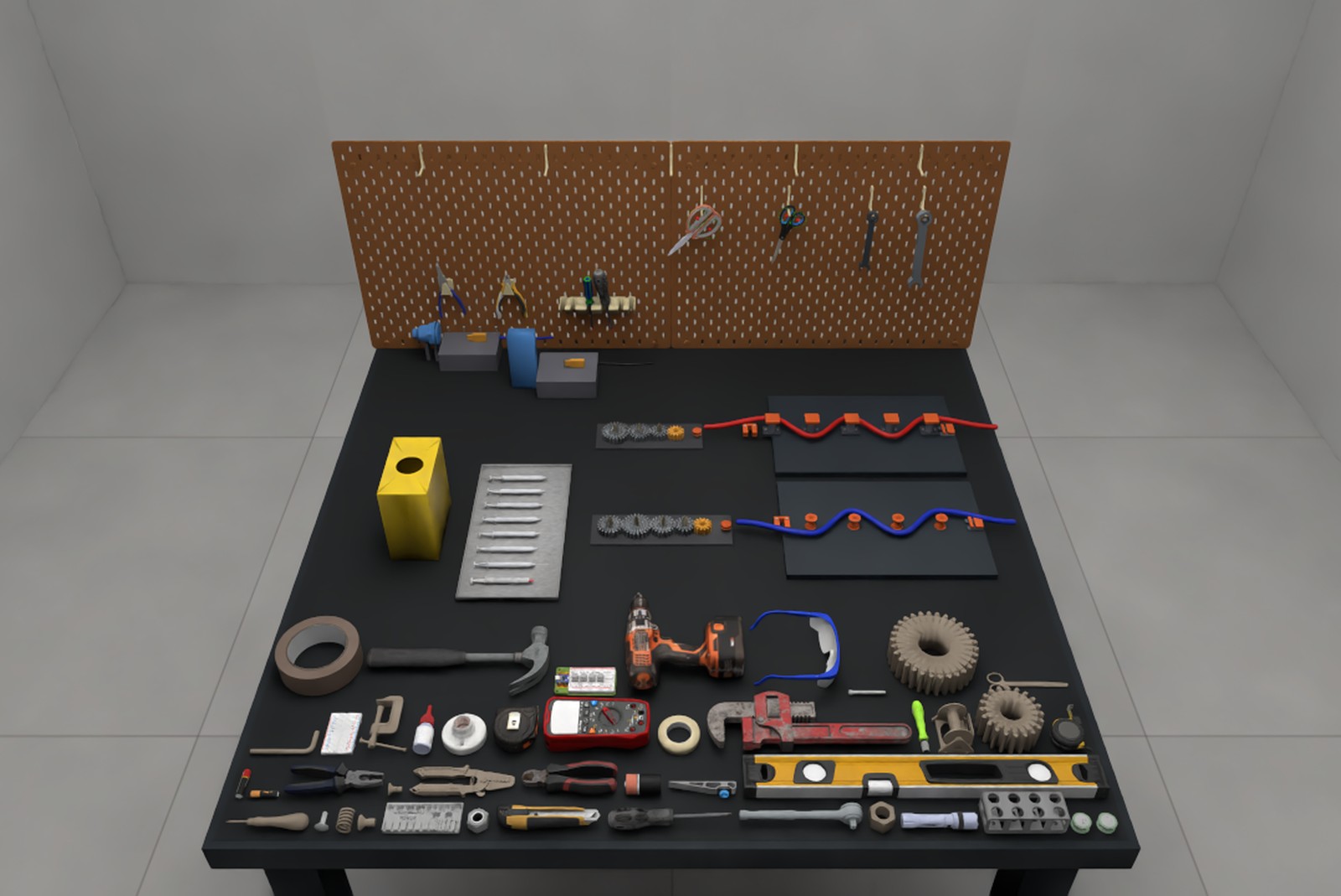
| Asset library | 55+ normalised assets | Industrial tools, mechanical components, medical supplies, fixtures, connectors and deformable objects, normalised in format, scale, appearance and collision geometry. |
| Robot embodiment | Single-arm Franka, bimanual YAM | Franka for reproducible tabletop manipulation; YAM for coordinated bimanual interaction, particularly with deformable objects. |
| Task specification | Extended BDDL | Tasks declare objects, initial configurations, variations and success conditions, for rigid and deformable objects alike. |
| Physics | NVIDIA Newton | Unified rigid and deformable dynamics, spanning rigid manipulation, contact-rich assembly and insertion, and cable routing. |
3Task execution records
Task-level success says whether an execution achieved its objective, not where or why it failed. VABAR records the evidence needed to relate outcomes to both the program's decisions and the resulting physical interaction.
| Mapping | Failures it localises |
|---|---|
| ot → ŝt | Perception or state-estimation failures |
| ŝt → at | Program-generation, planning, skill-selection or decision failures |
| at → (st+1, Ct) | Grasping, motion-execution, collision, contact or other physical-interaction failures |
| (st+1, Ct) → et+1 | Task verification, failure detection and recovery triggering |
Object poses and velocities describe the resulting scene configuration; contact records describe how that configuration arose. A failed placement may leave an object in an incorrect pose, while its contact history reveals whether it collided with a fixture, was supported by another object, or became jammed. VABAR records both, so failure attribution is grounded in the physical execution rather than in task-level success or software error messages alone.